
Self-Defence and Assault Charges in Turkey: When Force Is Lawful
Turkish law does not punish a person who acts out of the necessity of repelling an unjust attack — one that is taking place, or is certain to take place or to be repeated — against a right belonging to himself or herself or to another, provided the defence is proportionate to the attack in the circumstances of that moment (Turkish Penal Code No. 5237, Art. 25(1)). Where the limits of self-defence are exceeded out of excusable excitement, fear or panic, no penalty is imposed either (Art. 27(2)). Outside those limits, hurting someone in a fight is the offence of intentional injury, punishable by one year and six months to three years' imprisonment in its basic form (Art. 86), though the sentence is reduced where the act was provoked by the other person's unjust conduct (Art. 29).
Visitors and foreign residents are drawn into these cases in predictable ways: a bar or street argument, a dispute with a taxi driver, a neighbour or a landlord, a road-rage incident, a confrontation with someone harassing a companion. In most of them both sides are injured and both become suspects. This guide explains when force is lawful, what happens when it is not, how such cases are investigated, and what a foreigner should do in the first hours.
- Self-defence: no penalty where an unjust, present or imminent attack is repelled proportionately (Art. 25(1)).
- Defence of others is covered on the same terms.
- Necessity: no penalty for acts done to escape a grave and certain danger not knowingly caused, with no other means of protection, proportionately (Art. 25(2)).
- Excess through fear or panic: no penalty (Art. 27(2)).
- Other excess without intent: punished as the negligent offence, with a reduction (Art. 27(1)).
- Unjust provocation: sentence reduced by one quarter to three quarters (Art. 29).
- Intentional injury: 1 year 6 months to 3 years; if curable by simple medical treatment, 6 months to 1 year 6 months or a fine, on complaint (Art. 86).
- Against a woman: the minimum for the lighter form is nine months (Art. 86(2)).
Legal status of this guide. It reflects the Turkish Penal Code as in force. Whether force was justified is decided on the facts of each case, usually with forensic and video evidence. Last updated: October 2026.
In this guide
- The conditions of self-defence
- Proportionality
- When the limit is exceeded
- Unjust provocation
- The offence of intentional injury
- Mutual fights
- Arrest, statement and investigation
- How these cases end
- Consequences for foreigners
- What to do in the first hours
- Frequently asked questions
The conditions of self-defence
Article 25(1) contains each element in a single sentence. Courts examine them in turn.
Conditions relating to the attack
- There must be an attack. Human conduct directed against a legally protected interest. Words alone, however offensive, are not an attack that justifies physical force — they may be provocation.
- It must be unjust. There is no self-defence against a lawful act: an arrest by a police officer acting within his or her powers, or the defensive force of the person you attacked first.
- It must be directed at a right. Not only life and bodily integrity: liberty, sexual integrity, the inviolability of the home, honour and property are all rights that can be defended. The right may be your own or another person's, so a person who steps in to protect a stranger being beaten is covered.
- It must be present. The attack is taking place, or its occurrence or repetition is certain. Force used after the attack has ended and the attacker is leaving is retaliation, not defence. Force used against a merely possible future attack is premature.
Conditions relating to the defence
- Necessity. The defence must have been required to repel the attack. Turkish courts do not impose a general duty to flee, but where the attack could plainly have been avoided without harm — by closing a door, by walking away from someone who posed no immediate threat — necessity is in doubt.
- Directed at the attacker. Harm to a bystander is not covered by self-defence; it may fall under necessity or negligence.
- Proportionate to the attack, "according to the state and conditions at that moment".
Where these are met, the act is lawful. The defender is not convicted, pays no compensation to the attacker, and — where properly established at the investigation stage — is not prosecuted at all.
Necessity (Art. 25(2))
A related ground covers acts done to escape, or rescue another from, a grave and certain danger to a right, which the person did not knowingly cause and which could not be averted in any other way, provided there is proportion between the gravity of the danger and the means used. Breaking a car window to get a child out, or driving without a licence in a medical emergency, are of this kind. Unlike self-defence, the harm falls on someone who did nothing wrong, and the conditions are stricter.
Proportionality
Proportion is measured between the attack and the defence, not between the harms that resulted. The court looks at:
- the means used by each side — fists, a bottle, a knife, a firearm, a vehicle;
- the number, age, sex, strength and state of the people involved;
- the place and time — a dark street, a home at night, a crowded bar;
- what other means of defence were actually available at that moment;
- the right under attack — more force is acceptable to save a life than to save a wallet.
The judgment is made from the defender's position at the time, without hindsight. A person attacked by several people, or by someone visibly stronger or armed, may use a means that would be excessive against a single unarmed opponent. Equally, a blow with a weapon in answer to a push, or continued blows to a person already on the ground and no longer a threat, will not be accepted as proportionate.
Two recurring situations:
- Intruders in the home. An unlawful entry at night is an attack on the inviolability of the home and creates a real fear for the safety of those inside; courts give considerable latitude to occupants, particularly through the provision on excess caused by fear.
- Defence of property. Force may be used to stop a theft in progress, but serious injury or lethal force to protect property alone is unlikely to be proportionate.
When the limit is exceeded
The Code distinguishes how the limit was exceeded (Art. 27).
| Situation | Consequence |
|---|---|
| The limit of self-defence was exceeded out of excusable excitement, fear or panic | No penalty is imposed (Art. 27(2)) |
| The limit of a ground of justification was exceeded without intent — through carelessness in judging what was needed | If the act is also punishable when committed negligently, the penalty for the negligent offence is imposed, reduced by one sixth to one third (Art. 27(1)) |
| The limit was exceeded intentionally — the person knew the attack was over or the force unnecessary and continued | Full liability for the intentional offence, usually with a reduction for unjust provocation |
The second paragraph is the provision that matters most to an ordinary person suddenly attacked. The law accepts that someone in genuine fear cannot measure force precisely. What must be shown is that the conditions of self-defence existed — a real, unjust, present attack — and that the excess is explained by a state of mind that anyone in that position might have had. The victim's own statements made immediately after the event, the call to emergency services, the testimony of those who saw the person's condition, and the medical findings are the evidence of that state.
Mistake is treated in the defender's favour too: a person who, through an unavoidable mistake, believes that the conditions of a ground excluding liability exist — for example, reasonably taking a realistic imitation weapon for a real one — benefits from that mistake under the Code's provisions on error.
Unjust provocation
Many incidents are not self-defence at all: the attack was over, or was only verbal, and the response was anger. The Code then offers a reduction, not an acquittal. A person who commits an offence under the influence of rage or intense distress caused by an unjust act is punished with a reduced sentence — for ordinary offences, a reduction of one quarter to three quarters (Art. 29).
- The provocation must be an unjust act attributable to the victim: an assault, a serious insult, harassment of a companion, damage to property.
- It must have caused the emotional state in which the offence was committed.
- The size of the reduction depends on how serious the provocation was.
- A person who started the confrontation cannot rely on the other's reaction as provocation.
For insult specifically there are parallel rules: an insult in reaction to an unjust act can be punished more lightly or not at all, and one in reaction to an assault is not punished. See our guide to insult offences in Turkey.
The offence of intentional injury
Where force is not justified, the charge is intentional injury (Art. 86).
| Form | Penalty | Prosecution |
|---|---|---|
| Intentionally causing pain to another's body or impairing health or perception | 1 year 6 months to 3 years | Without a complaint |
| Where the effect is slight enough to be remedied by simple medical treatment | 6 months to 1 year 6 months, or a judicial fine; where committed against a woman, the minimum is 9 months | On the victim's complaint |
| Aggravated by the victim or the means: against a relative in the direct line, a spouse or sibling; against a person unable to defend himself or herself; because of the victim's public office; by abuse of a public office; with a weapon | Increased by half; investigated without a complaint | — |
| Aggravated by the result: permanent weakening or loss of a sense or organ, permanent difficulty in speech, permanent scarring of the face, danger to life, premature birth or loss of pregnancy, bone fractures | Increased substantially, with statutory minimums for the gravest results | — |
| Death resulting from an injury | A separate, far heavier range | — |
"Weapon" is defined widely. It includes not only firearms and knives but any object actually used to attack or defend that is capable of causing injury — a bottle, a glass, a stick, a stone, a belt, a chair. An ordinary bar fight in which a glass is used is therefore an aggravated offence.
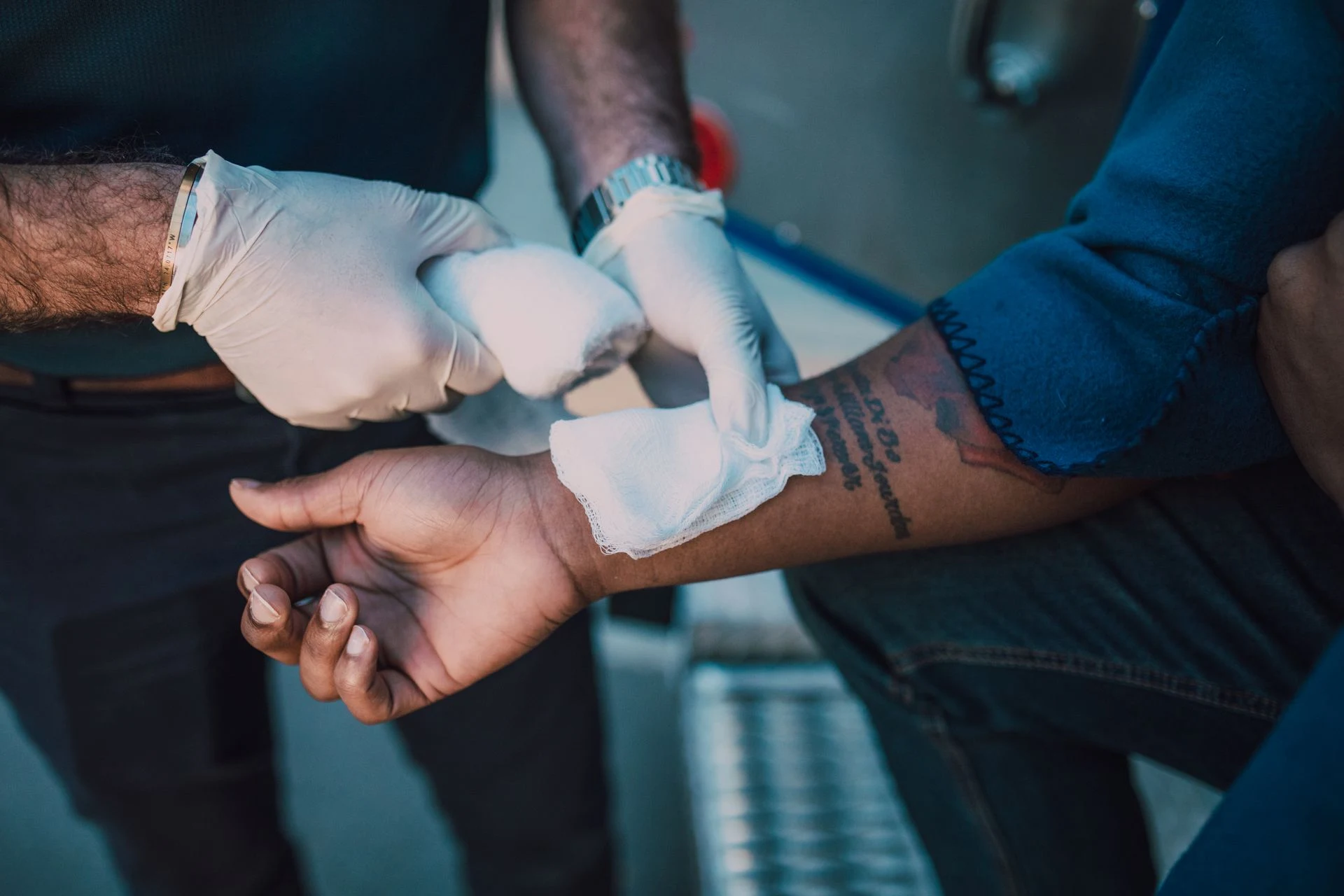
The classification depends on the forensic medical report, which states whether the injury can be remedied by simple medical treatment, whether there is a fracture and its degree, whether life was endangered and whether there is permanent damage. An initial report from the emergency department is followed, where necessary, by a final report from the forensic medicine institute. Both sides should make sure all their injuries are recorded on the day.
Mutual fights
In a mutual fight where it cannot be established who attacked first, neither side is treated as acting in self-defence, and both are prosecuted for the injuries they caused. Courts then commonly apply the provocation reduction to both at the minimum rate, on the footing that the first unjust act cannot be attributed to either.
That is why evidence of who started it decides these cases: camera footage, independent witnesses, the pattern of injuries (defensive wounds on the forearms; injuries to the back), the first call to the police, and consistent statements. A foreigner in a dispute with a local in the local's neighbourhood should not assume that witnesses will be neutral; video is the most valuable evidence there is.
Arrest, statement and investigation
- At the scene. The police separate the parties, call ambulances and take both to hospital for examination and reports — including the person who was attacked, who is often also taken into custody.
- Custody and rights. You must be told why you are held, in a language you understand. You have the right to an interpreter, to a lawyer before and during questioning — appointed without charge on request — to have a relative and your consulate informed, and to remain silent. See our guide to being arrested in Turkey as a foreigner.
- The statement. This is where self-defence is established or lost. Describe the attack concretely: who did what, with what, in what order; what you feared; why you could not avoid it; what you did and when you stopped. "I pushed him away because he had grabbed my throat" is a defence. "We had an argument and then fought" is a confession to a mutual fight. If you are complaining of the other person's conduct, say so expressly: you are a victim as well as a suspect, and your complaint must be recorded.
- Evidence. Ask, through your lawyer, for specific cameras to be secured, named witnesses to be heard and your injuries and torn clothing to be photographed.
- Prosecutor's decision. Release; release under judicial control such as a ban on leaving the country; or referral to a judge with a request for detention. Detention is unusual for simple injury and likely where a weapon was used or the injury is serious.
How these cases end
- Non-prosecution. Where the evidence clearly establishes self-defence, the prosecutor can decide not to prosecute.
- Mediation. Intentional injury, except in its form aggravated by a serious result, is subject to victim–offender mediation. An agreement — an apology, payment of medical costs, mutual withdrawal — closes the case without a conviction. In a mutual fight this is the commonest outcome. Note that a case closed by settlement excludes compensation for any time spent in custody; see our guide to compensation for wrongful detention.
- Withdrawal of complaint ends the case for the light form of injury, which is prosecuted only on complaint.
- Trial. In the criminal court of first instance for most injuries; the heavy penal court for the gravest. The court may acquit on self-defence, find excess through fear and impose no penalty, or convict with reductions for provocation and good conduct.
- Sentence. For a first offender, short sentences are commonly converted to a fine, suspended, or made subject to deferred announcement of the verdict.
- Civil liability. A person who acted in lawful self-defence owes no compensation to the attacker. A convicted defendant can be sued for treatment costs, lost earnings and non-pecuniary damages.
Consequences for foreigners
- Leaving Turkey. A ban on leaving the country is frequently imposed on foreign suspects until statements and reports are complete. It can be challenged, and lifted once an address for service through a lawyer is given. See our guide to judicial control and travel bans.
- Immigration. The police report the incident to the migration authorities. A deportation decision on public-order grounds can be issued on the strength of an investigation alone, before any court has ruled on self-defence. It must be appealed within seven days; see our guide to appealing a deportation order.
- Residence and citizenship. A pending case delays applications; a conviction, even with a deferred verdict, is seen in the security assessment. See our guide to criminal records in Turkey.
- Being the victim. If you were the one attacked, your status does not limit your rights as a victim; where the attacker is a partner or family member, protective orders are available at once — see our guide to protection orders in Turkey.
Detained or summoned after a fight in which you were defending yourself? The first statement decides how the case is classified. Message Yayla Law on WhatsApp or use the contact form before you give it, with where you are being held and what happened.
What to do in the first hours
- Stop as soon as the danger has passed, and move away. Force after that point is what turns a defender into a defendant.
- Call 112 yourself. The person who calls for help is more readily believed to be the one who was attacked.
- Get every injury recorded at hospital — scratches, bruises, torn clothing. Photograph them.
- Identify cameras and witnesses and tell the police at once.
- Do not discuss the incident with the other party or their friends, and do not agree to "settle it" for cash on the spot.
- Ask for an interpreter and a lawyer before giving a statement. Wait for them.
- Give a precise, chronological account and file your own complaint against the attacker.
- Do not sign anything you cannot read.
- Stay polite with the police. Insulting or resisting an officer is a separate offence that will follow you long after the fight is forgotten.
- Tell your consulate.
Frequently asked questions
Is self-defence legal in Turkey?
Yes. A person who proportionately repels an unjust, present or imminent attack on his or her own rights or another's is not punished.
What if I used more force than necessary?
If the excess resulted from excusable fear, excitement or panic, no penalty is imposed. If it was careless, the lighter negligent offence applies with a reduction. If deliberate, you are liable for the intentional offence, usually with a provocation reduction.
Do I have to retreat before defending myself?
There is no general duty to flee, but the defence must have been necessary. Where the attack could obviously have been avoided safely, a court may find it was not.
Can I use force to protect someone else?
Yes. Defence of another person's rights is covered on the same conditions.
He insulted me and I hit him. Is that self-defence?
No. Words are not an attack that justifies physical force. They may count as unjust provocation, which reduces the sentence by a quarter to three quarters.
What is the penalty for assault in Turkey?
Intentional injury carries one year and six months to three years; six months to one year and six months or a fine where the injury is slight; and more where a weapon was used or the result is serious.
Both of us were injured. What happens?
Both are investigated. If it cannot be shown who started it, both are usually prosecuted with reductions, and mediation is offered.
Can I be stopped from leaving Turkey?
Yes, by a judicial ban on leaving the country during the investigation. It can be challenged and is often lifted once your statement is taken and a lawyer is appointed.
Can I be deported even if I acted in self-defence?
A deportation decision can be issued on public-order grounds before the criminal case is decided. It must be appealed within seven days, and the self-defence evidence is central to that appeal.
Legal basis and sources
- Turkish Penal Code No. 5237, Articles 6, 25, 27, 29, 30, 86 and 87 — official consolidated text at mevzuat.gov.tr.
- Criminal Procedure Code No. 5271, Articles 147, 202 and 253 — mevzuat.gov.tr.
- Law on Foreigners and International Protection No. 6458, Article 54.
This article provides general legal information on Turkish law as of October 2026. It is not legal advice. Whether force was lawful depends on the specific facts and evidence of each incident.