Knives and Weapons in Turkey: What You Can Carry and What Is a Crime
Turkish law prohibits the sale, purchase, carrying and possession of a defined class of bladed and impact weapons — daggers, switchblades, stilettos, sword canes, machetes, swords, bayonets, pointed and grooved knives, maces, knuckledusters, garrottes and similar instruments made specially for attack and defence (Law No. 6136 on Firearms, Knives and Other Instruments, Arts. 4 and 5). Carrying or possessing one is punished with six months' to one year's imprisonment and a judicial fine (Art. 15). Kitchen knives, tools and sports or work knives are outside the Law — but carrying even these "solely for the purpose of use in attack, according to the circumstances" is punishable with up to three months' imprisonment or a fine. Carrying or possessing a firearm without a licence carries two to four years' imprisonment (Art. 13).
Visitors to Turkey (Türkiye) are rarely armed on purpose. They are stopped with a folding knife bought as a souvenir, a multi-tool on a keyring, a pepper spray in a handbag, a hunting knife in a camper van, or a blank-firing pistol sold openly in a market. This guide explains what is prohibited, what is tolerated and in what circumstances, what happens at a search, and how these cases are defended.
- Prohibited outright: the instruments listed in Article 4 and anything similar made specially for attack and defence.
- Outside the Law: household implements, and knives and tools used in medicine, industry, agriculture, sport or a trade — when carried for that use.
- Penalty for prohibited knives and instruments: six months to one year and a fine; increased by half to double if grave in number or nature.
- Ordinary knives carried for attack: up to three months or a fine.
- Firearms without licence: two to four years and a fine; one to three years for a single weapon kept at home or at work.
- Importing prohibited knives: two to five years (Art. 14); firearms, far more.
- Use in an offence: a weapon aggravates injury, threat, robbery and other crimes.
- Confiscation follows in every case.
Legal status of this guide. It reflects Law No. 6136 as amended, most recently on firearms penalties by Law No. 7533 of November 2024, Law No. 5729 on sound and gas-cartridge weapons, Law No. 2521 on hunting and sporting shotguns, and the Turkish Penal Code. Whether a particular knife falls within Article 4 is decided by expert examination and case law on its design features; the treatment of pepper sprays and similar devices has not been uniform. Last updated: October 2026.
In this guide
- Three categories of object
- Prohibited knives and instruments
- Ordinary knives and tools
- Firearms
- Blank-firing, air and gas weapons, pepper spray
- Airports, borders and souvenirs
- Stops and searches
- When a weapon is used in another offence
- Procedure and likely outcomes
- Defence points
- Consequences for foreigners
- Frequently asked questions
Three categories of object
| Category | Examples | Rule |
|---|---|---|
| Prohibited instruments (Art. 4(1)) | Dagger, stiletto, switchblade, sword cane, machete, sword, bayonet, pointed and grooved knives, mace, knuckleduster, garrotte, and similar items made specially for attack and defence | Manufacture, import, sale, purchase, carrying and possession prohibited; criminal offence |
| Instruments outside the Law (Art. 4(3)) | Household implements; knives, skewers, rasps and similar needed for medicine, industry, agriculture, sport or a trade or craft | Free to own and to carry for their purpose; offence only if carried solely for use in attack |
| Firearms | Pistols, revolvers, rifles; their ammunition and essential parts | Licence required; unlicensed possession or carrying is a serious offence |
Prohibited knives and instruments
- The list. Article 4 names specific types and adds "similar instruments of a special nature to be used solely in attack and defence". The Law then prohibits their sale, purchase, carrying and possession (Art. 5), with an exception for knives whose use is necessary for a trade or craft and whose manufacture is permitted by regulation.
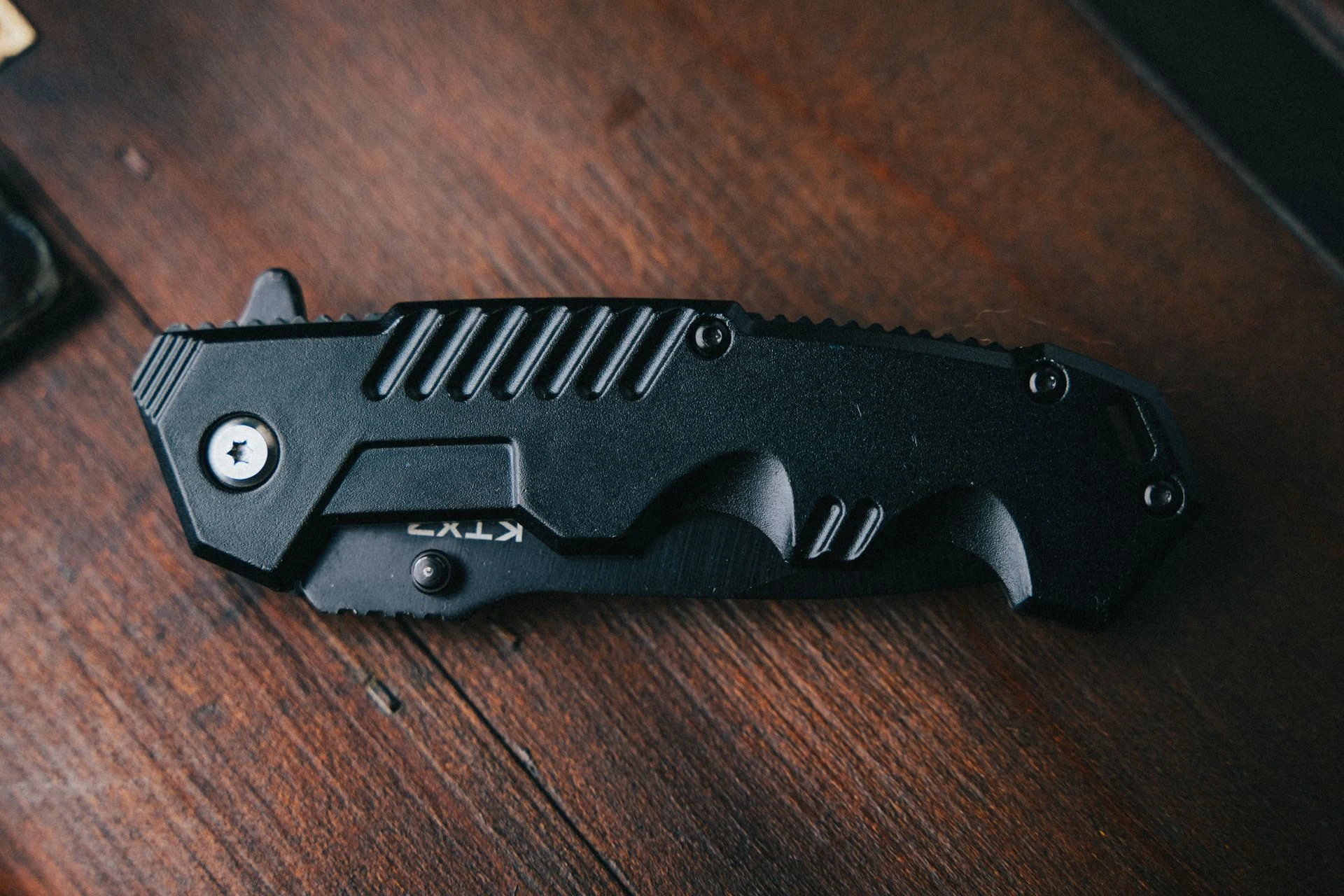
- How courts identify them. The seized item is sent for expert examination. Features that point to a prohibited instrument: a double-edged blade; a pointed tip combined with a blood groove; an automatic opening mechanism operated by a button or spring (switchblade); a guard and grip designed for stabbing; concealment within another object. Features that point away: a single-edged blade without groove, a manual folding mechanism, a design typical of kitchen, camping or pocket use.
- Possession is enough. Unlike ordinary knives, a prohibited instrument is an offence in the pocket, the car and the home alike.
- Penalty. Six months to one year's imprisonment and a judicial fine of not less than twenty-five days for selling, brokering, buying, carrying or possessing (Art. 15(1)); increased by half to double where the items are grave in number or nature (Art. 15(2)).
- Permitted trade knives misused. Those who carry or possess a knife whose manufacture is permitted for a trade "outside its purpose of use" are punished in the same way (Art. 15(3)) — a butcher's knife in a nightclub.
- Import, manufacture, transport. Bringing prohibited knives or instruments into the country, attempting to, making them, or transporting them from place to place is punished with two to five years' imprisonment and a fine; the penalty is reduced by up to half where the items are few or of minor nature (Art. 14).
- Typical tourist items in this category: switchblades and "flick" knives sold in bazaars; butterfly knives; knuckledusters, including novelty ones; daggers sold as ornaments; sword canes; throwing stars.
Ordinary knives and tools
- Not subject to the Law. "Household implements, instruments used in medicine, industry, agriculture and sport, and knives, skewers, rasps and the like needed for the practice of a trade or craft" are outside the Law's provisions (Art. 4(3)).
- The purpose test. Carrying such knives and instruments "solely for the purpose of use in attack, according to the state and circumstances" is punished with up to three months' imprisonment or a judicial fine (Art. 15(4)).
- What "circumstances" means in practice:
- Where and when: a kitchen knife in a picnic basket is one thing; the same knife in a waistband outside a bar at 3 a.m. is another.
- How carried: packed with camping gear or tools, or concealed on the body and ready to hand.
- Why: a fisherman, cook, diver or tradesman on the way to work has an evident reason.
- Conduct: an argument, a threat or intoxication at the time.
- Pocket knives and multi-tools of the ordinary folding kind are not prohibited instruments. They are nonetheless taken at venue entrances, courthouses, stadiums, public transport security and airports, and can become the subject of a file if found during a street search in suspicious circumstances.
- Stadiums and sports events. The sports violence legislation separately criminalises bringing cutting, piercing and similar objects into sports venues.
- Schools, courthouses, government buildings and demonstrations have their own prohibitions.
Firearms
- Licence. Firearms may be carried or kept only by those the Law lists and those granted a carrying or possession licence by the governorate, under conditions of age, health, criminal record and need (Art. 7). A possession licence allows keeping the weapon at a stated home or workplace only; a carrying licence is granted to limited categories.
- Foreigners cannot in practice obtain a personal licence, with narrow exceptions under reciprocity and for diplomatic and protective staff. Foreign licences are not valid in Turkey.
- Penalties (as amended in November 2024):
- buying, carrying or possessing a firearm, its ammunition or essential parts contrary to the Law: two to four years' imprisonment and a judicial fine of one hundred to five hundred days;
- where the firearm is of the fully automatic or other aggravated types, or the weapons, ammunition or parts are grave in number or nature: five to eight years and a heavier fine;
- where a single non-aggravated firearm with a customary number of cartridges is kept at home or at the workplace: one to three years and a fine;
- a very small number of cartridges alone may be treated more leniently at the court's discretion (Art. 13).
- Import and trafficking: bringing firearms or ammunition into the country, or trading in them, carries long prison sentences (Art. 12).
- Hunting and sporting shotguns fall under a separate law with a registration certificate; rifled hunting and sporting arms need a licence under Law No. 6136. Visiting hunters bring weapons only through the authorised hunting-tourism procedure with temporary import permission.
- Antique and deactivated weapons require a certificate; a "decorative" pistol that can be made to fire is a firearm.
- Inherited weapons. A licensed weapon left by a deceased relative must be reported and transferred or surrendered within the statutory period; an heir who simply keeps it commits the possession offence. See our guide to inheritance formalities.
Blank-firing, air and gas weapons, pepper spray
- Sound and gas-cartridge pistols ("blank guns") are regulated by Law No. 5729. They may be bought only by adults meeting the conditions, must be notified to the governorate within the period after purchase and recorded on a notification card, and may not be carried outside the home or workplace or used in public; breaches are punished with administrative fines and confiscation, and firing in a manner causing fear can be the offence of endangering public safety.
- Converted blank guns. A blank-firing weapon altered to fire live ammunition is expressly treated as a firearm under Article 13. Many street "bargains" are of this kind.
- Air rifles and pistols are sold freely within power limits and are not firearms; using them to injure is the offence of injury with a weapon.
- Pepper spray. Small defensive sprays are sold openly. The legislation does not regulate them clearly, and decisions have differed on whether carrying one is an offence; they are confiscated at security checks, are prohibited on aircraft, and using one on a person other than in lawful self-defence is injury with a weapon.
- Stun guns and electric shock devices are treated restrictively and are best not carried.
- Fireworks and flares are subject to explosives rules and stadium bans.
Airports, borders and souvenirs
- Arriving. A prohibited knife or a firearm part in your luggage is not a customs formality: bringing Article 4 instruments into the country is the import offence (two to five years), and firearms are worse. Declare anything doubtful before the control.
- Cartridges and magazines forgotten in a bag after a hunting or shooting trip abroad are a recurring cause of arrest at Turkish airports, including for transit passengers whose bags are screened. A single cartridge can be treated leniently by the court, but the passenger will first be detained, questioned and often miss the flight.
- Transit. If your hold baggage is rechecked in Turkey, Turkish law applies to its contents.
- Souvenirs. Ornamental daggers, yataghans and swords sold in tourist shops may be prohibited instruments or, if old, cultural property that cannot be exported. Ask for an invoice and a certificate that the item is a modern decorative reproduction with an unsharpened blade; pack it in hold luggage; expect questions. See our guide to taking antiques out of Turkey.
- Diving and camping knives, kitchen sets, tools: hold luggage only.
- Vehicles. Motorists entering by land should clear the car of knives beyond ordinary camping use, batons and sprays.
Stops and searches
- Preventive searches of persons, bags and vehicles in public places are carried out on a judge's order or, in urgent cases, the written order of the local administrative authority, for the purposes set out in the police powers legislation; entry controls at venues, malls, stations and airports are routine.
- Stop and identity check. Police may stop a person on reasonable grounds and ask for identification; a pat-down for weapons is permitted for safety.
- If something is found, a seizure report is drawn up. Ask for a copy. You have the right to silence, a lawyer and an interpreter before any statement.
- Unlawful searches. Evidence obtained by a search without the required order can be excluded; the lawfulness of the search is the first thing a defence lawyer checks.
See our guides to police searches and rights on arrest.
When a weapon is used in another offence
The Penal Code defines "weapon" broadly: firearms, explosives, every kind of cutting, piercing or bruising instrument made for attack and defence, other things suitable for use in attack and defence even if not made for that purpose, and burning, corrosive, wounding, suffocating or poisonous substances (Art. 6). A bottle, a stone or a kitchen knife is a weapon when used as one.
- Intentional injury with a weapon: the penalty is increased by half, and the offence is prosecuted without complaint.
- Threat with a weapon: two to five years' imprisonment.
- Robbery with a weapon: the aggravated form with a heavy minimum sentence.
- Brandishing or firing in a way that causes fear and panic: the offence of intentionally endangering public safety, six months to three years.
- Self-defence. Using a weapon to repel an unlawful attack can be justified if proportionate; carrying a prohibited weapon "for protection" is not a defence to the possession charge. See our guide to self-defence in Turkey.
- Separate punishment. The possession offence under Law No. 6136 is charged in addition to the offence committed with the weapon.
Procedure and likely outcomes
- Investigation. Seizure, expert report on the item, statement. Custody is brief in knife cases; in firearm cases the prosecutor commonly asks for judicial control or detention.
- Detention cannot be ordered for offences with a maximum of two years or less — which covers the knife possession offences — but is available for firearm offences. See our guide to pre-trial detention.
- Court. The criminal court of first instance.
- Typical outcome for a first offender with a prohibited knife: a short sentence that is converted to a fine, suspended, or made subject to deferral of the announcement of the verdict; the knife is confiscated.
- Fast-track and simplified procedures may be applied to the lesser forms. See fast-track procedure and deferred verdicts.
- Unlicensed firearm: a custodial sentence in the range of years; suspension is possible only if the final sentence is two years or less.
- Appeal within two weeks. See criminal appeals.
Defence points
- Is it an Article 4 instrument at all? Challenge a superficial expert report; ask for examination by the forensic laboratory with reasons by reference to design features.
- Was there a purpose of attack? For ordinary knives, the prosecution must show from the circumstances that the knife was carried solely for attack. A plausible, documented innocent reason defeats the charge.
- Lawfulness of the search.
- Knowledge and possession. An item in a shared car or borrowed bag; a cartridge forgotten in a pocket: the mental element must be proved.
- Mistake of law is a narrow defence, but a tourist's good-faith purchase from a licensed shop, with invoice, is relevant to intent and to sentencing.
- Minor nature. The reductions for small number and minor nature, and for a very small number of cartridges, should be claimed expressly.
- Interpreter and translation of the statement: an admission recorded without proper interpretation can be contested.
Consequences for foreigners
- A weapons conviction is weighed in the public order assessment for residence permits, their extension and citizenship.
- A deportation decision may be taken where the authority considers the person a threat to public order or security; firearm offences and any use of a weapon against a person make this likely. See our guides to deportation after conviction and deportation appeals.
- A pending case can come with a travel ban. See judicial control.
- The record remains in the criminal register until the conditions for deletion are met. See criminal records.
Stopped with a knife or other item in Turkey, or charged under Law No. 6136? Send the seizure report and a photograph or description of the item. Message Yayla Law on WhatsApp or use the contact form. We examine the expert report and the search, and defend the case from the first statement.
Frequently asked questions
Is it legal to carry a pocket knife in Turkey?
An ordinary folding pocket knife is not a prohibited instrument, but carrying it solely to use in an attack is an offence, and it will be taken at security checks.
Which knives are illegal?
Daggers, stilettos, switchblades, sword canes, machetes, swords, bayonets, pointed and grooved knives, and similar items made specially for attack and defence.
What is the penalty for carrying a prohibited knife?
Six months to one year's imprisonment and a judicial fine, with confiscation.
Can I bring a hunting or diving knife on holiday?
A knife designed for sport or work may be brought for that use, in hold luggage. A double-edged or grooved fighting knife may not.
Can a foreigner own a gun in Turkey?
In practice no, apart from narrow exceptions. Unlicensed possession carries two to four years' imprisonment.
Is pepper spray legal?
It is sold openly but not clearly regulated; it is confiscated at checks and using it other than in lawful self-defence is an offence.
Can I buy a decorative dagger or sword as a souvenir?
Only a modern blunt reproduction with an invoice, packed in hold luggage; a functional dagger is a prohibited instrument, and an old one may be protected cultural property.
I forgot a bullet in my bag. What will happen?
You will be questioned and a file opened. A very small number of cartridges can be treated leniently by the court.
Does using any object as a weapon count?
Yes. Anything suitable for attack — a bottle, a stone, a kitchen knife — is a weapon when used as one, and aggravates the offence.
Legal basis and sources
- Law No. 6136 on Firearms, Knives and Other Instruments, Articles 4, 5, 7, 12, 13, 14 and 15 — official consolidated text at mevzuat.gov.tr.
- Turkish Penal Code No. 5237, Articles 6, 86, 106, 149 and 170 — mevzuat.gov.tr.
- Law No. 5729 on Sound and Gas-Cartridge Weapons; Law No. 2521 on Hunting and Sporting Shotguns.
- Criminal Procedure Code No. 5271, Articles 100 and 116–119; Law No. 2559 on Police Duties and Powers.
This article provides general legal information on Turkish law as of October 2026. It is not legal advice. Classification of an item depends on expert examination.